February 21, 2011

Firefly: The Complete Series


I'd never seen a Joss Whedon show before (Buffy, Angel, Dollhouse), but this short-lived one seemed like it had both a cult following and critical acclaim, so I bought it a couple of months ago for a low price and figured, for better or worse, that I'd be done with it soon enough. The series lasted for fourteen episodes and even if I didn't like it, my logic was that it'd be "over" soon enough. The good news is that I did come to like the series. The bad news is that it took about half of the series for me to do so. Let's start with the premise. Firefly has often been described as a Western set in space. And I can attest to the accuracy of this genre-merging description. In a nutshell, it takes place in the very distant future where humanity has spread to a wide range of planets and star systems. But out on the "rim" or "fringe" of the civilized galaxy lies a frontier of sorts in which there just isn't enough official jurisdiction to prevent lawlessness. It's a frontier just like the Old West. To drive the point home, the writers even have many of the frontier planets' residents speaking in some hokey Southern backwoods accents and - for whatever reason - everyone's in 19th century regalia for the most part. The whole thing kind of works. It's science fiction, for sure, but there are no aliens or laser beams or anything; good old fashioned gunplay abounds and there's horseback riding aplenty. To call it steampunk wouldn't be fair, but also wouldn't be entirely unwarranted. Anyway, the premise of a Western in outer space intrigued me, but I probably should have known, going in, that fourteen forty-four-minute episodes is a very long series to enjoy based solely on a concept. I'd need to understand and appreciate the characters themselves, too, in order to enjoy the series. And as I already kind of said, it took me several episodes to get to do so. I'm not sure whether the blame for that rests with the show, with me, or with Fox itself for drastically fucking up the order and presentation of the episodes. See, the pilot episode of the series is two hours long. But my understanding is that, at the last minute, Fox said, "we don't want to kick off this series with a two-hour episode," and the Firefly folks were forced to overhaul the second episode into one that could serve as a worthy introduction. And then the third, fourth, and fifth episodes were each also affected, to varying extents, as content from the pilot also needed to be shown in each of those. So for those of us viewing the series on DVD, we get a two-hour pilot episode, and then we get another four straight episodes that each rehash a little bit of that pilot episode. So, yeah. Clunky-feeling, I guess. In spite of all the introduction and exposition, I still found myself confused about the relationships between various characters right up through those first five or six episodes - likely not because the show had failed to establish them, but because my own interest had waned beyond the point of caring to commit them to memory. Ultimately, the series and I did find our "groove," so to speak, but by then I was already halfway finished with it. It goes against the nature of backlog-clearing to revisit any movie or TV show that I've previously seen, but I'd definitely be interested in re-watching this series, especially those earlier episodes, if given any excuse to do so. (Maybe a friend or girlfriend would like to try it out? And wouldn't mind watching those first few episodes with me? Anyone?) Once I got over whatever hump there was, I enjoyed the character-driven stories that dominated the latter half of the series. The series finale - which was really just the last episode produced before cancellation was official and production shut down - was actually pretty fitting and, while it's always a shame when a series gets cancelled midseason, I think the "loose ends" here are fewer and farther between than with many other series that suffered the same short-lived fate. Also, there is of course still the motion picture Serenity which I'm hoping serves as an adequate epilogue to provide closure for the series and its characters. I'll probably get to that movie tonight or tomorrow. In the mean time, have a happy Presidents Day.

February 16, 2011

Moby-Dick


I've been reading this all time classic for a year and a half now. But while it took me from August '09 to February '11 to get through the first forty percent of the book, I've conquered the final sixty percent in the last week alone. And I have some very mixed feelings about the novel. I apologize in advance if this post becomes exceedingly lengthy or sloppy at times or too all-inclusive for its own good - although I can't think of a more suitable post for an exceedingly lengthy, sometimes sloppy, all-inclusive book like Moby-Dick. Let's start with the good. At its best, Moby-Dickreads like a beautiful poem or a pitch-perfect song. Adventure abounds. The narrator - we can call him Ishmael - offers absurdly deep philosophical reflection on a multitude of elements of the human experience. He spends whole chapters thinking and wondering about history, geography, social issues both in America and in the world at large, and the human experience in general. It's simply amazing that Melville was able to take something so simple - a long and arduous boat ride - and stretch it into 135 chapters that fire upon so many different subjects and topics. Ishmael will be laboring while tied at the waist to a fellow whaler for security, and it'll pique a lengthy discussion about holy matrimony and the ties that bind, for example. Symbolism abounds in places both obvious (Ahab's quest for revenge against the "white whale" has become a pop culture metaphor for obsession) and minute, such as the way the nationalities of the crew members allows their interactions to parallel many international discords past and present (present being 1850, of course). You get the sense while reading Moby-Dick that Melville has tried to embed a deeper meaning into nearly every event that occurs over the enormous span of 135 chapters. And that's commendable. It's obvious to me, having read the book now, why the novel is such an English teacher's wet dream. You can analyze sentence after sentence for thematic nuances or "big picture" worldly meaning and never run out of metaphors and new ways to interpret the text. It is, all things considered, one of the smartest and most carefully written books I have ever read. That said, let's turn to my biggest issue with the novel: it is not very well paced. I know this may seem like a self-contradicting statement, as I only just referred to Melville's writing as both "smart and careful" and "like a pitch-perfect song." But while it's true that individual chapters and scenes in Moby-Dick each work extremely well, the sum of the parts leaves a bit to be desired. Ishmael is sloppy, at times, in laying out his paragraphs and sentences. There are entire chapters that exist simply as an addendum to previous chapters. "I'd like to go back and expand upon the tools used for the oil-rendering process," Ishmael will say, a few chapters after the one about oil-rendering. Perhaps it's an artifact of the way novel writing worked in the 1850s, but why not just go back during the editing process and expand upon that chapter within the confines of, say, that chapter? Maybe Melville intentionally allowed Ishmael to backtrack and expand upon his earlier narrative. Maybe Melville felt that it added a more human or realistic tone to Ishmael's story. But first of all, I doubt that, and second of all, either way, it felt distracting and sloppy. It's one thing to tell a story out of order for effects like juxtaposition and flashbacks and parallels and two separate timelines having back-to-back climaxes within the narrative, but this wasn't a case of breaking chronological order for effect. It was only a case of "oh yeah, I forgot to mention something earlier." There was a unique narrative frame - or lack thereof - for Moby-Dick in which different chapters served very different purposes. Some advanced the story, some allowed Ishmael to wax philosophical about something or other, and some were very detailed lessons on the whaling industry and various components of the practice. There are four straight chapters, for example, in which Ishmael simply compares and contrasts sperm whales and right whales. Some chapters are even written with stage directions, which sort of disrupted the narrative flow for me; in a first-person narrative, why have occasional soliloquies and dialogues for which the narrator isn't present? One of the longest chapters in the book consists of Ishmael defending the whaling practice as a noble and timeless one. One of the shortest involves Ishmael eating breakfast. The way it's all put together gives you the sense that the novel is trying to be too many types of books all at once. Is it a reference book about whaling? Partially, yes, and it's clear that Melville has done exhaustive research on the practice. But is it not an epic adventure story? Well, yes - it's that too. And is it a stream-of-conscious rambling of sorts? Most definitely. And it succeeds at all the different things it tries to be. But as a whole, it feels identity-less, almost. I can't really put it any better than this negative review of Moby-Dick from 1851: "An ill-compounded mixture of romance and matter-of-fact. The idea of a connected and collected story has obviously visited and abandoned its writer again and again in the course of composition." Another small complaint I'll tack on is that Melville was extremely heavy-handed with the foreshadowing, going so far as to have a Far Eastern harpooner occasionally prophesy the impending doom of Ahab and his ship. Bad omens pop up every few chapters and toward the end of the book Melville is essentially screaming "they're all gonna die!" right in our faces. I know literary devices exist for a reason, but I preferred the obvious conclusion of the story to be hinted at, rather than outright forecasted at various points throughout the tale. Melville does a great job at slowly creating a foreboding sense of doom, but he ruins it, in my mind, by dwelling on it in the foreground rather than letting it build up menacingly in the background. All of that said, the book's conclusion was pretty enjoyable to read. Ahab descends ever more into madness and it's in these final chapters that the story feels purest from a narrative framework standpoint. With Ahab's fall imminent, Ishmael wastes no time describing the whaling industry anymore or pondering social norms and customs. Instead, it's nothing but mood-setting and plot development. The inevitable ending did feel a tad abrupt, and I can see why some readers might be upset that after hundreds of pages of build-up, the climax and falling action took all of a few pages to get through. Frankly, I was just glad the book was over. So yeah. Moby-Dick was beautiful and impressive, but not without some major and fundamental flaws - namely, that it tried to be too many different things all at once. I can't really say whether or not anyone else should bother reading it. Just be warned, should you choose to do so, what you're getting yourself into. But by the same token, get ready for one of the deepest and most interesting texts that the Western canon has to offer.

February 13, 2011

Swordfish


I'm ten years late to this party, but yeah, Halle Berry's boobs were in this movie. Also, it was about some hackers and terrorists. But those three aspects of the film - hackers, terrorists, and Berry's boobies - are the three things I knew the film would have going in. I have to admit, I was a little bit impressed by the minor twist ending. Not because it was unique or original in any way, but because John Travolta's character essentially told us all how the movie would end in the first scene. The acting here was pretty iffy, especially for a cast that featured Don Cheadle, Hugh Jackman, and Halle Berry. Travolta has put forth plenty of stinkers, but may have been the best actor of all the leads. Ultimately, this wasn't a great movie, or even a particularly good one. But it wasn't as bad as I worried it would be, either. Let's call it a C-plus and get on with our Sundays.

February 12, 2011

The I.T. Crowd: Seasons 1-4

It's odd that the discussion on The I.T. Crowd was rekindled today, as I watched a number of episodes throughout the series (what should I use instead of "series" for British shows?) today to have finally finished it all off. Not too hard, as I had seen 15 or so beforehand and the 4 seasons have resulted in a whopping 24 total episodes. Anyway, as with Trevor, I really can't tell what makes this show so addicting. It's basically a look at the lives of I.T. guys Roy, the slacker; Moss, the socially-challenged geek; and Jen, their computer-illiterate boss. A lot of the jokes come from the disconnect between tech-savvy people and everyone else, but that's hardly the basis of the show. The easy jobs they all have give them a lot of time to goof off and get into classic sitcom hijinks. I'd say it has as much to do with computers as Always Sunny does with bars- it's just a part of the setting really. I think the humor mostly derives from the over-acting. A few of the characters really ham it up and go overboard. I'll cite this scene, a favorite of mine- after the CEO of Reynholm Industries commits suicide (a great scene on its own), his long-lost son shows up at his funeral like this. Then that's quickly followed by this. It's a show that is continually focused on wackiness- every time you think the classic sappy-but-funny sitcom moment is about to happen, it doesn't. And as a final selling point, this is the easiest to understand British show I've ever seen. So yeah, this is good stuff, and I wish there were more than six episodes each season- I'll have to wait for series 5.

The Human Centipede

Is this the most disgusting movie I've ever seen? Yes, it is.

February 11, 2011

The Hurt Locker


So that was 2009's "Best Picture" winner. Alright. I can see the case. The Hurt Locker is a movie about a three-man bomb squad in Iraq. And the thing is, it's really only about those three men and the bombs they're disarming. There are very few supporting characters. There is very little narrative. We're not told much about any of the scenes we watch; typically, there's a bomb, and our boys must disarm it. They are often successful and sometimes less than successful. The whole thing just feels very realistic, and that allows the tension and suspense to maintain very consistently high levels. Off the top of my head, the only other Iraq War movie I can remember seeing is Jarhead, and that was a very different movie that took place 20 years ago during a very different war. Jarhead is about how boring and patience-testing modern war can be. The Hurt Locker focuses more on how exciting and dangerous modern war can be. Both are great films, and attempting to compare them is an apples and oranges type of exercise. I'm not sure if I loved the ending of The Hurt Locker from a movie narrative standpoint. However, I totally "get" the significance and meaning of it. I know that sounds vague, and if you haven't seen the movie yet, I'm sorry. (Also, see the movie.) Like the blurb on the DVD cover, I would say that this was a "near-perfect movie." So, you know, a nine on a scale of ten. I'm not sure if I think it was the best movie released in 2009. That said, it beats the shit out of Avatar.

February 9, 2011

The Kite Runner


I’m trying to blog tonight, but I’ve got to admit... I’m not much in the mood to write. More than that, I don’t really know what to say about this book either. Don’t get me wrong. The novel was good. Damn good. (I’m sure everyone already knew this, though; considering the book’s immense popularity, I’m probably the last person here to read it.) However, my brain’s feeling so blasé at the moment I can’t come up with any insightful response on this reading.
You know what, I’ll forego any plot explanation - like I said before, I’m sure you’ve all read it (and if you haven’t, what are you waiting for?) - and just delve into whatever gut feelings I’ve got; considering my brain’s on holiday. Aside from the strong story structure or its powerful, moving characters, I’ve got to say that this at least opened my eyes - if even only a little bit - to life in the Middle East. The book was release in 2003, so I think I’m trying to look at the material back when America was starting to turn bigoted against all Middle Easterners. Then this story comes along and, while fiction, reminds us how people are people and you can’t just lump an entire race in with one evil group - in this case, the Taliban. At it’s core, the book is about family and the ability to find redemption and forgiveness within one’s soul for sins that haunt our past. These are message that - on some level - most everyone can relate to. Using these themes as a vessel, author Khaled Hosseini draws upon sympathy and compassion from his readers as they look upon the Afghanis in a kinder, more understanding light.

Or maybe I’m completely wrong with this. I don’t know. But for one who’s only understanding of the Middle East comes from movies and news reports that depict nothing but rumble amidst a desert wasteland, clouded in violence and bloodshed; I gained a sad realization of what it would be like to be chase from your home at the brink of war only to return decades later unable to walk down the same streets you carelessly played on as a child in fear of being gunned down. Seeing strangers taking hold in a dilapidated refuge that used to be your warm house. Losing your innocent paradise you once knew as home.

I wonder when Hosseini first started writing this? Looking him up on Wiki, he began his career as a doctor here in SoCal and then just randomly switched jobs and popped this baby out two years after 9/11. If this was some sort of master plan in an attempt to shine a tolerant/understanding light on Americans as they began to look upon all Middle Easterners as their enemies, then I’m impressed. But if this was just story because it’s a story, then I’m also impressed.

It’s a good book. Go and read it. Oh, wait. I bet you already have.

February 8, 2011

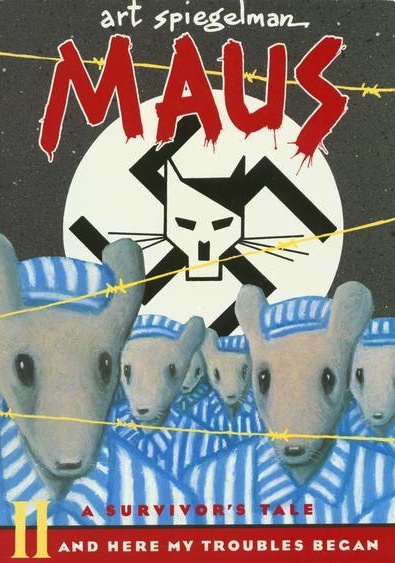
Maus II


Well, shit sure did hit the fan in Maus II as the focus shifted from evading the Nazis to being a prisoner in Auschwitz. In my last post, I made a remark about the folly of trying to judge a complete work based solely on its first half. And I stand by that remark; not only did I enjoy Maus II and get a lot out of it, but I also appreciate Maus I all the more in hindsight. I think I began to understand more fully the story Art Spiegelman was trying to convey. It isn't just one about how his father survived the Holocaust; it's just as much a story about how Art himself has dealt with being the son of such a troubled man. There's a lot more introspection and the fourth wall all but vanishes at some points. An early scene shows Art talking to his wife about the book he's writing. "What kind of animal will I be in your book?" asks his wife, albeit being a mouse within the context of the scene. Since she is French, Art's wife could be depicted as a frog. But since she converted to Judaism, she could also be a mouse. This paradox really helps drive home a message I think I missed in Maus I: that it is foolish to try to divide racial and ethnic groups into animals. This becomes a recurring theme of sorts, as there is a German Jew in Auschwitz who the Jews see as a cat but who the Nazis see as a mouse. I think when all is said and done, I still got more out of Persepolis than I did from Maus, but that's probably because I've seen or heard or watched half a dozen stories about the horrors of the Holocaust whereas Persepolis took me to a place I'd never seen before - namely, Iran during the Islamic Revolution and the Iran-Iraq War. I give both bio-graphic novels (see what I did there?) two thumbs up, and you should venture forth and read either series with confidence. I mean, if you trust me, and all.

February 5, 2011

Friday Night Lights: Season 3

A testament to the addictive properties of Friday Night Lights: not 24 hours after I finished season 2, season 3 has been completed. Though slightly shorter, season 3 was at least a full season of television with a true finale and everything, which is good- I like some closure after all that drama! Season 3 is when some main characters start departing. First off, Santiago, who I liked in season 2, is never mentioned at all. Just seems kinda sloppy that they don't even reference his character, but whatever. Two other characters over the course of the season are appropriately written off the show, and I really liked how it was done- both of their departures truly felt like the culmination of their character arcs, plus it's hard to keep characters on a show about high school when they graduated the year before. In addition, most of the main cast is dealing with the pressures of senior year and getting into college while simultaneously focusing on a potential second state title, all while dealing with the classic relationship drama we've come to know and love in Dillon Texas. Although I liked the running theme in the season that everyone's time together was soon coming to an end, the show is about a football season, which ended in December as far as I can tell. Where's the closure when they've still got a few more months together? Well, I'll tell you where. After the last football game is played, the season finale takes place five months later and provides a nice look at the last days of senior year. While some characters will be sticking around, I'm not really sure exactly who will be gone forever, and a huge last-minute plot twist means there's plenty of possibilities for where to go next in season 4. I'll be taking a break from the series for a little bit while I do some business travel, but I'm sure when I'm back Gallagan's going to insist that we start watching again, so I'd expect season 4 to be posted later in the month.

Clerks the Animated Series Season 1


This series was amazing. I originally purchased the show on VHS so I have no problem posting it having rewatched it online. It's been a long time since I have seen all these episodes and I realized that the jokes get better the older you are (I being only 13 when I first saw it a lot of jokes just went over my head). The show features the good old cast from the movie Jay and Silent Bob as the two lowlifes who hang out selling various contraband outside the store, Randall and Dante as the clerks who run the video store and quick stop respectively, and it also features some excellent guest voice actors including Brian Pohsen, Alec Baldwin, Charles Barkley, and others.

This series pulled a lot of crazy stunts and it's no surprise that it only lasted two episodes on ABC before it was cut. If this show were on adult swim or some network like that it may have survived to at the bare minimum see all 6 original episodes aired. Since the season is so short I can probably mention all the episodes. The warning before the first episode is typical of adult rated cartoons and warns that all celebrity impersonations are accidental except where noted in the credits but it also goes on to say that the pilot episode was lost and unfortunately found so now the viewer is forced to watch it. They redeem themselves by informing the viewer that they can stay tuned for a better episode the next week.
The second episode starts with a clip show of past episodes (all just clips from episode one). The cast find themselves locked in a cold freezer thinking back on their lives. The also "jump the shark" in this episode when they remember old Happy Days episodes for a good portion of the twenty odd minute episode.
The third episode starts with the main characters reading fan mail only to find that the fans want to know where all the women and black people are. Therefore they introduce a new character named Lando who is black and full of wisdom that they refuse to heed.
The fourth episode follows the trite plot line that all shows have some sort of legal battle. In this case Jay slips on some spilled soda and Randall stupidly trying to prove a point goads a "high powered Lawyer" into take on his case to sue the quick stop. The jury ends up being the NBA all star team and the judge is Judge Reinhold who keeps day dreaming of another adventure with Axel Foley (Eddie Murphy from Beverley Hills cop).
Episode five is simply just a whole mess of movie parodies including but not limited to Indiana Jones and the temple of doom.
The final episode Dante and Randall don't leave the convenience store and discuss the stupidity of pop culture while absolute chaos unfolds just outside their doors. Jay and Silent Bob continually pop in to inform them of such things as a carnival, the death of the president by trampling from an ape, the presidents head being transplanted onto the ape, and the continual cheating of Dante's somewhat girlfriend.

All in all this single series of the animated show Clerks is worth watching. Had it been picked up by a less family friendly network than ABC I am sure that it would have survived a little longer. The dvd commentary mentions ideas for future episodes that include J and Silent Bob purchasing KITT from Nightrider, Jay becoming a boy band star and Silent Bob being hired at the Quick Stop and turning it into a successful business.